
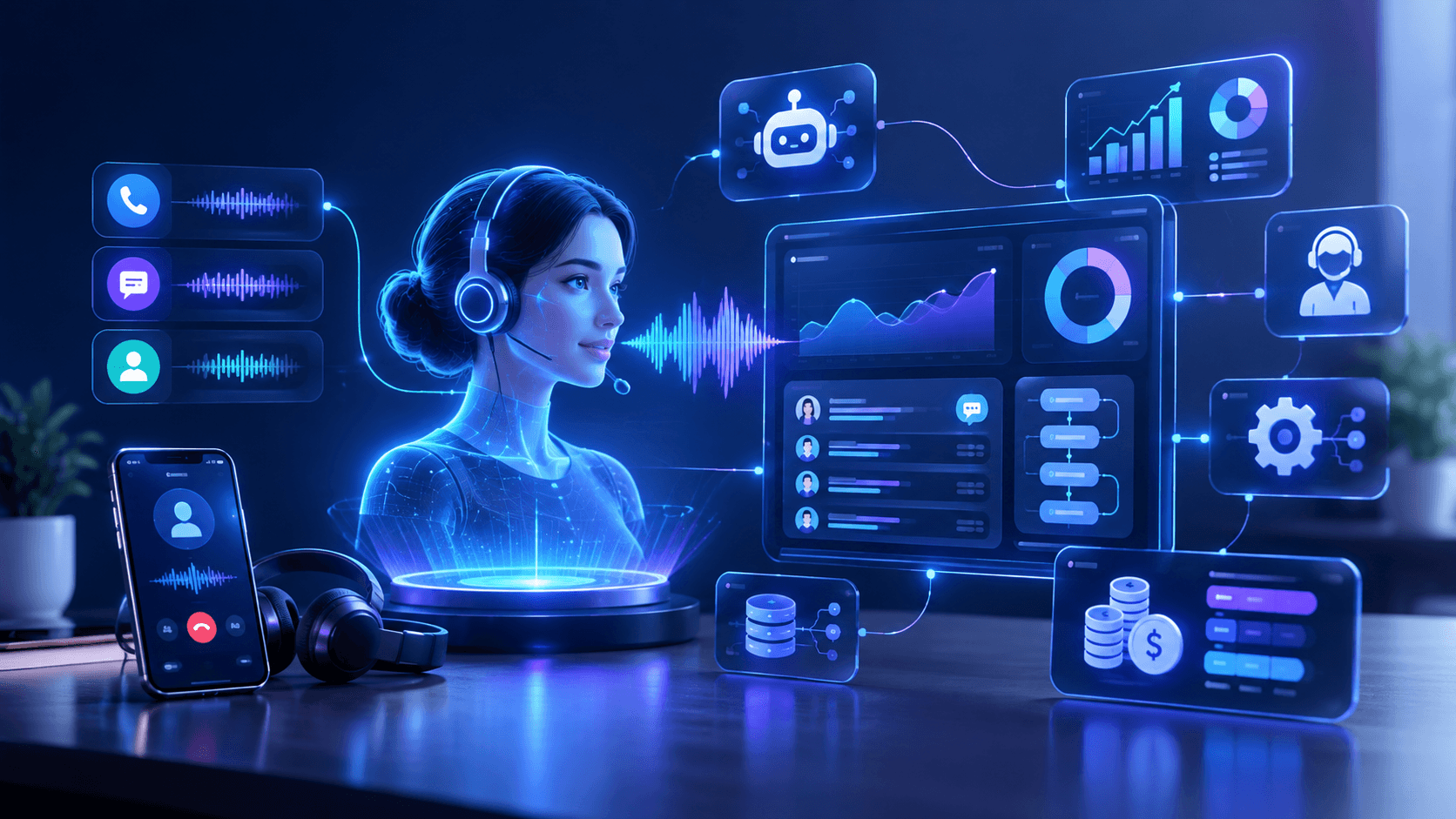
If you've ever called a business and been greeted by a voice that sounds almost human, answered your questions naturally and even booked an appointment without putting you on hold, you've likely interacted with an AI voice agent.
AI voice agents are quickly becoming one of the most practical applications of artificial intelligence for businesses in 2026. They're not science fiction anymore. They're answering calls, qualifying leads, booking appointments and handling customer support right now for businesses across Mumbai, Bangalore, Delhi and cities worldwide.
But how do they actually work? What makes them different from those frustrating old IVR systems everyone hates? And most importantly, what do they really cost?
This guide breaks it all down in plain language, with real numbers and practical insights based on what's actually happening in the market today.
What is an AI Voice Agent?

An AI voice agent is software that uses artificial intelligence to have natural, human-like phone conversations with callers.
Unlike traditional IVR (Interactive Voice Response) systems that make you "press 1 for sales, press 2 for support," AI voice agents understand spoken language, respond contextually and carry on a real conversation.
They can handle inbound calls (customers calling your business) or make outbound calls (calling customers for follow-ups, reminders or surveys). They work 24/7, never take breaks and can handle multiple calls simultaneously.
Key Difference from Old Phone Systems
Traditional IVR: Rigid menu system. Press buttons. No flexibility. Frustrating user experience.
AI Voice Agent: Understands natural speech. Responds contextually. Adapts to conversation flow. Sounds human.
Example conversation with traditional IVR:
"Press 1 for appointments. Press 2 for billing."
Caller: "I want to reschedule my appointment."
System: "Invalid input. Press 1 for appointments."
Example conversation with AI voice agent:
Agent: "Hi, this is Maya from ABC Clinic. How can I help you today?"
Caller: "Hey, I need to move my appointment to next week."
Agent: "Sure, I can help with that. You currently have an appointment on March 15th at 3 PM. What day next week works better for you?"
See the difference? The AI voice agent understands intent, remembers context and responds naturally.
How AI Voice Agents Actually Work (Technical Breakdown Made Simple)
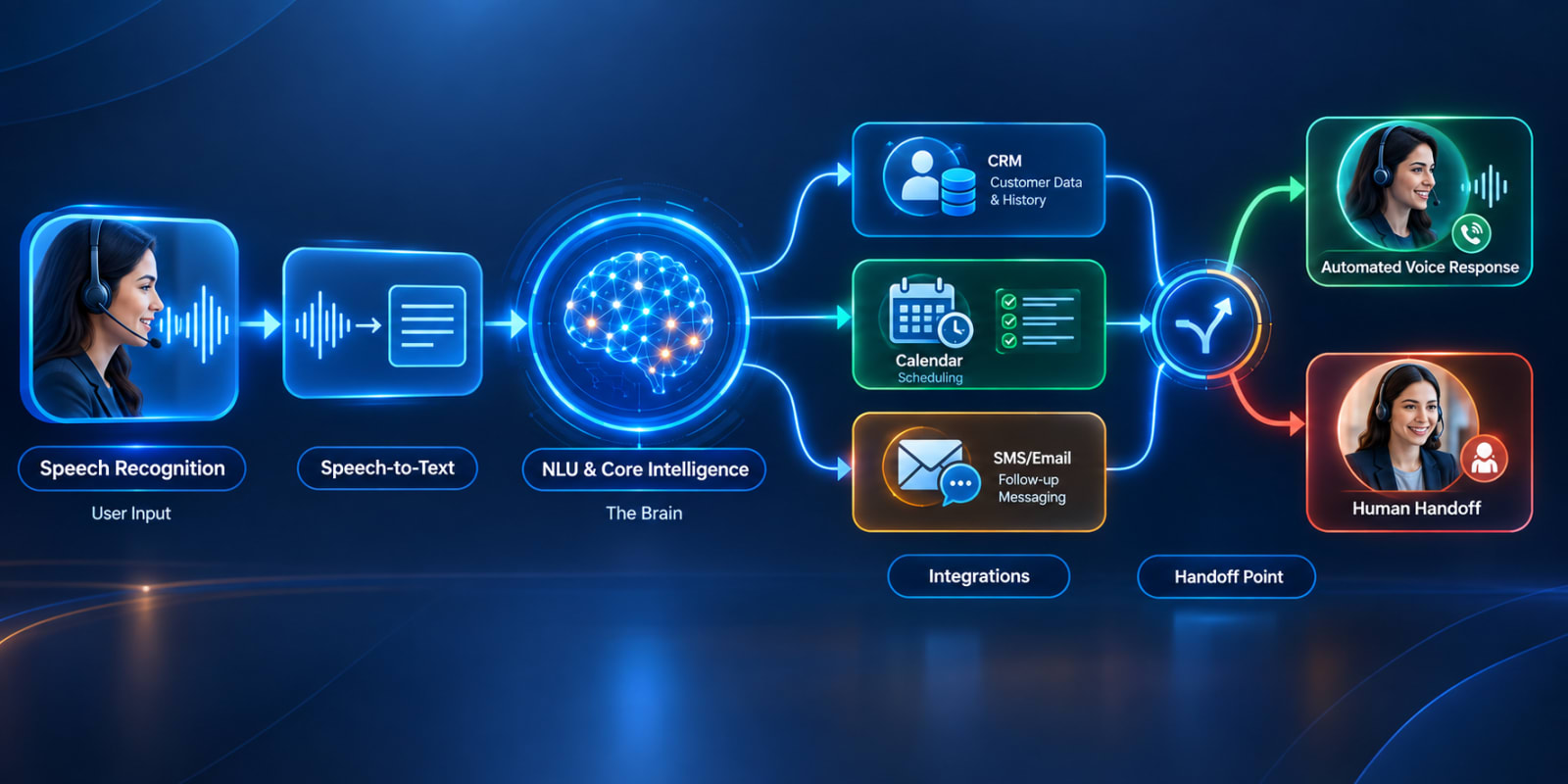
Understanding how AI voice agents work helps you evaluate them better and set realistic expectations. Here's the process broken down into digestible steps:
Step 1: Speech Recognition (Speech-to-Text)
When a caller speaks, the AI first converts spoken words into text using Automatic Speech Recognition (ASR) technology.
Modern ASR engines can understand different accents, handle background noise and process speech in real time with over 95% accuracy in clear conditions.
In India, advanced AI voice agents can understand English, Hindi, Hinglish and regional languages depending on configuration.
Step 2: Natural Language Understanding (NLU)
Once speech is converted to text, the AI needs to understand what the caller actually means, not just what words they said.
This is where Natural Language Understanding comes in. The AI analyzes the intent behind the words.
Example:
Caller says: "Can I come in tomorrow instead?"
The AI understands the intent is to reschedule an appointment, even though the word "reschedule" wasn't used.
Step 3: Decision Making and Response Generation
Based on the understood intent, the AI decides what action to take and what to say next.
This happens through AI models (often Large Language Models like GPT-4, Claude or specialized conversational AI) that generate contextually appropriate responses.
The AI can also access your business systems in real time. It checks calendars for availability, pulls customer data from your CRM or verifies order status from your database before responding.
Step 4: Text-to-Speech (Voice Synthesis)
The generated text response is converted back into natural-sounding speech using Text-to-Speech (TTS) technology.
In 2026, TTS voices sound remarkably human. They have natural intonation, appropriate pauses and can even convey emotion when needed.
You can choose from different voice types, accents, speaking speeds and languages based on your brand and audience.
Step 5: Conversation Management
Throughout the call, the AI maintains conversation context, remembers what was discussed and handles interruptions or clarifications naturally.
If the conversation goes beyond the AI's capability, it seamlessly transfers to a human agent with full context of what was already discussed.
Step 6: Integration and Action Execution
While talking, the AI can simultaneously perform actions like booking appointments in your calendar, updating CRM records, sending confirmation emails or SMS, creating support tickets or logging call notes.
All of this happens in real time during the conversation.
What Can AI Voice Agents Actually Do?
AI voice agents in 2026 can handle a surprisingly wide range of business functions. Here are the most common use cases:
1. Appointment Booking and Rescheduling
Perfect for clinics, salons, spas, consultants, service providers and any business that runs on appointments.
The AI checks available slots, books appointments, sends confirmations and handles rescheduling or cancellations.
2. Lead Qualification
When potential customers call, the AI asks qualifying questions about budget, timeline, needs and decision-making authority before routing to sales or scheduling a demo.
This saves your sales team from spending time on unqualified leads.
3. Customer Support and FAQs
AI voice agents handle common queries like order status, return policies, business hours, pricing, service availability and troubleshooting steps.
They escalate complex issues to human agents with full conversation history.
4. Order Taking and Processing
Restaurants, delivery services and retail businesses use AI voice agents to take orders over the phone, confirm details, process payments and arrange delivery.
5. Reminders and Follow-Ups
AI can make outbound calls to remind customers about upcoming appointments, pending payments, abandoned carts or service renewals.
6. Surveys and Feedback Collection
After a purchase or service, AI voice agents can call customers to collect feedback, ratings and reviews in a natural conversational format.
7. Call Routing and Reception
Acting as a virtual receptionist, AI voice agents greet callers, understand their needs and route them to the right department or person.
8. Insurance and Healthcare Queries
AI handles patient queries, insurance verification, symptom checking (basic triage) and appointment scheduling for healthcare providers.
What AI Voice Agents Cannot Do (Important Limitations)
Setting realistic expectations is crucial. Here's what AI voice agents still struggle with in 2026:
Complex problem-solving that requires human judgment. AI can follow decision trees and handle most scenarios, but truly unique situations may need escalation.
Handling highly emotional or sensitive conversations. While AI can detect frustration and adjust tone, deeply emotional calls (complaints, grievances, crisis situations) are better handled by humans.
Perfect accuracy in very noisy environments. Background noise, poor phone line quality or heavy accents can still cause comprehension issues, though this has improved significantly.
Understanding highly technical or domain-specific jargon without proper training and configuration.
The best implementations combine AI for routine tasks with seamless human handoff for complex scenarios.
What AI Voice Agents Cost in 2026 (Real Market Pricing)
Cost varies significantly based on features, call volume, customization level and whether you're using a SaaS platform or building a custom solution.
Option 1: SaaS Platform Subscription (Ready-Made Solutions)
These are plug-and-play platforms where you configure an AI voice agent using templates and integrations.
Examples: Bland AI, Synthflow, Vapi, Retell AI
Pricing structure:
Base subscription: ₹8,000 to ₹25,000 per month
Per-minute charges: ₹2 to ₹8 per minute of call time
Setup and configuration: ₹0 to ₹15,000 one-time
Best for: Small to medium businesses, straightforward use cases like appointment booking or basic support.
Typical monthly cost for 500 minutes of calls: ₹15,000 to ₹35,000
Option 2: Custom-Built AI Voice Agent
A development agency builds a tailored AI voice agent integrated deeply with your existing systems, workflows and business logic.
Pricing structure:
Development cost: ₹80,000 to ₹3,00,000 one-time (depending on complexity)
Monthly platform and API costs: ₹5,000 to ₹20,000
Maintenance and updates: ₹8,000 to ₹25,000 per month
Best for: Businesses with unique workflows, complex integrations, high call volumes or specific compliance requirements.
Total first-year cost: ₹2,00,000 to ₹5,00,000
Option 3: Hybrid Approach
Using a SaaS platform but with custom configuration, advanced integrations and professional setup by a development partner.
Pricing structure:
Setup and customization: ₹30,000 to ₹80,000 one-time
Platform subscription: ₹10,000 to ₹30,000 per month
Ongoing support: ₹5,000 to ₹15,000 per month
Best for: Growing businesses wanting professional implementation without building from scratch.
Typical first-year cost: ₹2,50,000 to ₹4,50,000
Cost Factors That Impact Pricing
Call volume: More minutes used means higher per-minute charges.
Complexity of conversations: Simple appointment booking costs less than multi-step sales qualification.
Number of integrations: Connecting to CRM, calendar, payment systems, databases adds development time.
Language and accent requirements: Multi-language support or regional accent training increases cost.
Custom voice: Using a branded voice clone instead of standard AI voices costs extra.
Compliance and security: Healthcare, finance or legal industries may need additional security measures.
ROI Calculation: Is an AI Voice Agent Worth It?
Let's run a real-world scenario to calculate return on investment.
Scenario: Healthcare Clinic in Mumbai
Current situation:
Receptionist handles 40 calls daily
60% are appointment bookings/rescheduling
Time spent per call: 4 minutes average
Receptionist salary: ₹25,000 per month
Calculation:
40 calls x 60% = 24 calls that could be automated
24 calls x 4 minutes = 96 minutes (1.6 hours) daily
1.6 hours x 26 working days = 41.6 hours monthly
Labor cost for these calls: (41.6 / 208 total monthly hours) x ₹25,000 = ₹5,000
AI Voice Agent Cost:
SaaS platform subscription: ₹12,000/month
24 calls x 4 min x 26 days = 2,496 minutes monthly
Per-minute charges (₹4/min): 2,496 x ₹4 = ₹9,984
Total monthly cost: ₹21,984
Direct cost comparison shows higher expense, but consider these benefits:
Zero missed calls. No more lost appointments because the receptionist was busy.
24/7 availability. Patients can book anytime, even after hours.
Receptionist focuses on in-clinic patients instead of phone interruptions, improving patient experience.
Scalability. Handle 100 calls per day during peak seasons without hiring additional staff.
Data capture. Every call is logged with full details for follow-up and analytics.
For this clinic, even if direct labor savings don't cover the full cost, the business value (more bookings, better service, staff efficiency) makes it worthwhile.
Scenario 2: Service Business with High Call Volume
Current situation:
120 calls daily (60% routine queries)
2 full-time phone support staff at ₹20,000 each = ₹40,000
Overtime during peak times: ₹8,000 monthly
AI handles 70% of routine calls:
Reduces need to 1 support staff + AI agent
Staff cost savings: ₹20,000 + ₹8,000 = ₹28,000
AI cost: ₹18,000 to ₹25,000 monthly
Net monthly savings: ₹3,000 to ₹10,000
Annual savings: ₹36,000 to ₹1,20,000
Plus improved response time, consistency and customer satisfaction.
How to Choose the Right AI Voice Agent Solution
If you're considering implementing an AI voice agent, here's a practical decision framework:
Evaluate Based on Use Case Clarity
Define exactly what you want the AI to handle. Be specific. "Handle customer calls" is too vague. "Book appointments for 3 service types, check availability in real-time calendar and send SMS confirmations" is clear.
Start with a Pilot
Don't automate everything at once. Pick one function, test for 4 weeks, measure results and refine before expanding.
Check Integration Capabilities
Can it connect with your existing calendar, CRM, booking system or database? Seamless integration is crucial for real-time information access.
Test Voice Quality
Request a demo with your actual use case. Does the voice sound natural? Does it handle your specific conversation flows well?
Understand Escalation Process
How does the AI transfer to a human when needed? Is context passed along? This makes or breaks user experience.
Review Analytics and Reporting
Can you track call volume, common queries, success rates and areas where AI struggled? Good data helps you improve over time.
Clarify Ownership and Flexibility
If you go custom-built, do you own the code? Can you switch providers if needed? Avoid vendor lock-in.
Working with 4Byte Agency for Custom AI Voice Agents
At 4Byte Agency, we build custom AI voice agents tailored to your business processes, not generic templates.
You work directly with founders and senior engineers who understand both AI technology and business operations. We provide fixed written quotes, full code ownership and post-launch support to ensure your AI voice agent delivers real value.
Whether you need appointment booking automation, lead qualification, customer support or custom workflows, we build solutions that integrate seamlessly with your existing systems.
Get a free consultation:
📞 +91 79771 33658
📧 contact@4byte.agency
🌐 https://www.4byte.agency
📍 Malad West, Mumbai
Final Thoughts: Are AI Voice Agents Right for Your Business?
AI voice agents make sense when you have high call volume with repetitive queries, need 24/7 availability without staffing costs, want to improve response times and customer experience or need your team freed up from routine calls to focus on complex work.
They might not be the right fit yet if your call volume is very low (under 50 calls weekly), every call requires deep human judgment or empathy or your processes aren't documented or standardized yet.
The technology is mature, accessible and cost-effective in 2026. The businesses implementing AI voice agents now are gaining competitive advantages in service quality, operational efficiency and scalability.
Start small. Test one use case. Measure impact. Then expand based on results.