You've decided AI automation makes sense for your business. The question now is which type to implement first.
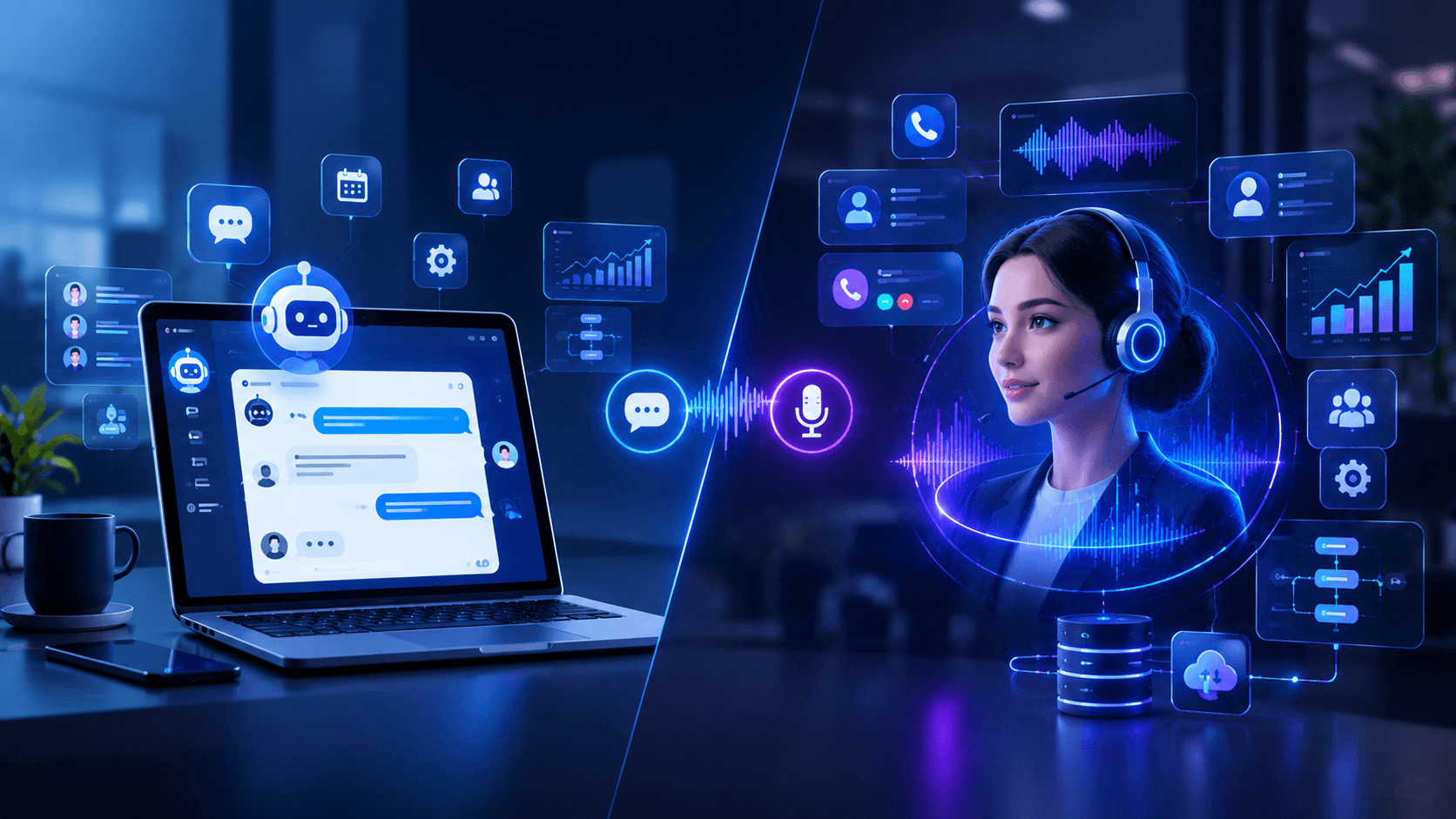
Should you go with an AI chatbot that handles text conversations on your website and messaging apps? Or invest in an AI voice agent that answers phone calls?
Both solve communication problems. Both save time. Both can dramatically improve customer experience. But they work differently, cost differently and fit different business scenarios.
This isn't about which technology is "better." It's about which one solves your actual business problem right now with the resources you have available.
By the end of this guide, you'll have a clear framework to make this decision based on your customer behavior, budget, team structure and business goals, not just what sounds impressive.
The Core Difference Between AI Chatbots and AI Voice Agents
Before diving into comparison, let's establish what each technology actually is.
AI Chatbots: Text-Based Conversational Interfaces
AI chatbots communicate through written text across platforms like your website live chat, WhatsApp Business, Facebook Messenger, Instagram DMs, Telegram or SMS.
Customers type their questions. The AI reads, understands intent and responds in text format. The conversation happens asynchronously, meaning customers can leave and come back without losing context.
Modern AI chatbots understand natural language, remember conversation history across messages and can pull information from your databases to give personalized answers.
AI Voice Agents: Phone Call Automation
AI voice agents handle actual phone conversations using speech recognition and synthesis technology.
They answer inbound calls from customers or make outbound calls for reminders, follow-ups and surveys. The conversation happens in real time through spoken words, just like talking to a human agent.
The AI understands spoken language, responds with natural-sounding speech and can perform actions like booking appointments or updating records while talking.
The Fundamental Distinction
Communication medium: Text vs voice
Interaction style: Asynchronous (chatbot) vs real-time (voice agent)
Customer preference: Typing vs talking
Use context: Digital channels vs phone calls
Understanding this distinction is the first step in choosing the right solution for your business.
When AI Chatbots Make More Sense for Your Business
Certain business models, customer behaviors and operational structures naturally align better with chatbot implementation. Here's when chatbots should be your first choice.
Your Customers Prefer Digital Communication
If your target audience is younger (under 40), tech-savvy or simply prefers messaging over phone calls, chatbots match their communication style.
E-commerce brands, SaaS companies, digital agencies, online course creators and app-based services typically see higher engagement through chat than phone.
You Get High Volume of Repetitive Questions
Questions like "What are your business hours?", "Do you deliver to my area?", "What's your return policy?" or "How do I reset my password?" are perfect for chatbot automation.
If your support team answers the same 15 to 20 questions repeatedly every day, a chatbot can handle 70 to 80% of those instantly without human involvement.
Your Business Operates Across Multiple Messaging Platforms
Many businesses today engage customers on WhatsApp, Instagram DMs, Facebook Messenger and website chat simultaneously.
A properly built AI chatbot can operate across all these channels from one central system, maintaining conversation context even if a customer switches platforms.
Managing this manually requires multiple team members monitoring different apps. A chatbot unifies it all.
Visual Information Helps Your Customers
Chatbots can send images, product photos, infographics, PDFs, videos and clickable links within conversations.
If explaining your product or service benefits from visual aids, charts, catalogs or screenshots, text-based chat makes this seamless. Voice calls can't show visuals without additional steps.
You Want 24/7 Support Without Increasing Costs
Chatbots respond instantly at 3 AM on Sunday just as well as 3 PM on Tuesday. No overtime pay. No shift management. No hiring additional staff for after-hours coverage.
For global businesses serving customers across time zones, chatbots provide consistent availability without operational complexity.
Your Sales Process Involves Research and Comparison
When customers are in research mode, comparing options, checking specifications or browsing catalogs, they prefer taking their time.
Chatbots let them ask questions, review information at their own pace, leave the conversation and return later without feeling rushed. This matches how people make considered purchase decisions online.
Budget Constraints Favor Lower Initial Investment
Chatbots generally cost less to implement and maintain than voice agents, especially at the basic to mid-complexity level.
If budget is tight but you need automation now, chatbots offer faster ROI with lower upfront costs.
When AI Voice Agents Are the Right Choice
Voice agents shine in specific scenarios where phone communication is either preferred or necessary. Here's when voice should be your automation focus.
Your Customers Actually Call You
This seems obvious but matters most. If you receive 30+ calls daily and most are routine queries or bookings, a voice agent directly addresses your biggest operational bottleneck.
Restaurants, clinics, salons, home services, legal consultations, real estate agencies and appointment-based businesses fit this profile perfectly.
Immediate Response Expectation is Critical
When customers call, they expect immediate interaction. Being put on hold frustrates them. Missing their call loses business.
Voice agents answer instantly, every time, without wait times or "all our agents are busy" messages.
If your business loses revenue from missed calls or customers abandoning after long hold times, voice automation solves this directly.
Your Audience Prefers or Requires Phone Interaction
Certain demographics, particularly older customers or those less comfortable with technology, strongly prefer speaking over typing.
Healthcare, insurance, financial services and government-related services often serve audiences who want to talk through their concerns rather than type them.
Complex Information Exchange Happens Faster via Voice
Explaining detailed service options, gathering comprehensive information or walking through multi-step processes often happens faster through conversation than text back-and-forth.
Mortgage consultations, insurance quotes, legal intake or technical support troubleshooting can be more efficient through voice interaction.
Your Business Model Relies on Appointment Scheduling
If your revenue depends on keeping your calendar full with appointments, a voice agent can book, reschedule and confirm appointments 24/7 without human intervention.
The AI checks real-time availability, offers options, captures customer details and sends confirmations, all during a single call.
Personal Touch and Trust Building Matter
Voice carries tone, empathy and personality in ways text cannot fully replicate.
For businesses where trust and personal connection are crucial (healthcare, counseling, high-ticket services), voice conversations feel more human and build stronger relationships than text exchanges.
You Need to Make Outbound Calls at Scale
If your business requires calling customers for appointment reminders, payment follow-ups, delivery confirmations, survey collection or renewal notices, AI voice agents can make hundreds of calls daily without tying up your team.
Direct Feature Comparison: Chatbot vs Voice Agent
Here's a side-by-side breakdown of capabilities, costs and considerations:
Factor | AI Chatbot | AI Voice Agent |
Communication Channel | Website, WhatsApp, Messenger, Instagram, SMS | Phone calls (inbound and outbound) |
Response Speed | Instant, any time | Instant pickup, real-time conversation |
Customer Preference | Younger, digital-native audiences | All ages, especially 40+ demographics |
Multi-tasking Ability | Customer can browse while chatting | Requires full attention during call |
Visual Content | Can send images, videos, links, PDFs | Voice only, no visuals during call |
Conversation Record | Automatic text transcript available | Requires recording and transcription |
Best for High Volume | Unlimited simultaneous conversations | Handles multiple calls simultaneously but capacity depends on setup |
Implementation Time | 1 to 3 weeks for basic setup | 2 to 4 weeks for basic setup |
Setup Cost | ₹20,000 to ₹80,000 | ₹30,000 to ₹1,50,000 |
Monthly Operating Cost | ₹5,000 to ₹20,000 | ₹12,000 to ₹35,000 (with call volume charges) |
Integration Complexity | Moderate (API connections to platforms) | Higher (telephony systems + business tools) |
Language Flexibility | Easier multilingual support | Accent and language detection more complex |
Emotional Intelligence | Limited emotion detection from text | Better tone and sentiment detection from voice |
Interruption Handling | Not applicable (async) | Must handle interruptions naturally |
Best Use Cases | FAQs, product info, lead capture, order status | Appointment booking, support calls, reminders, consultations |
The Budget Reality Check

Cost often becomes the deciding factor, so let's be completely transparent about what you'll actually spend.
AI Chatbot Implementation Budget
Basic chatbot (FAQ automation, lead capture):
Setup: ₹20,000 to ₹50,000
Monthly platform cost: ₹3,000 to ₹8,000
First-year total: ₹55,000 to ₹1,45,000
Mid-level chatbot (multi-platform, CRM integration, personalization):
Setup: ₹50,000 to ₹1,20,000
Monthly platform + maintenance: ₹8,000 to ₹18,000
First-year total: ₹1,45,000 to ₹3,35,000
Advanced chatbot (AI-powered, complex workflows, multiple integrations):
Setup: ₹1,20,000 to ₹2,50,000
Monthly cost: ₹15,000 to ₹30,000
First-year total: ₹3,00,000 to ₹6,10,000
AI Voice Agent Implementation Budget
Basic voice agent (appointment booking, simple routing):
Setup: ₹40,000 to ₹1,00,000
Monthly platform + call charges (500 min): ₹15,000 to ₹25,000
First-year total: ₹2,20,000 to ₹4,00,000
Mid-level voice agent (CRM integration, lead qualification, outbound calls):
Setup: ₹1,00,000 to ₹2,00,000
Monthly cost (1500 min): ₹20,000 to ₹40,000
First-year total: ₹3,40,000 to ₹6,80,000
Advanced voice agent (custom workflows, multi-language, complex integrations):
Setup: ₹2,00,000 to ₹4,00,000
Monthly cost (3000+ min): ₹30,000 to ₹60,000
First-year total: ₹5,60,000 to ₹11,20,000
The cost difference is significant. Chatbots typically offer faster ROI for businesses with moderate budgets, while voice agents require higher investment but solve more critical operational bottlenecks for call-heavy businesses.
Can You Use Both? (And When That Makes Sense)
Many businesses eventually implement both chatbot and voice agent automation, but doing so simultaneously from day one rarely makes sense unless you're a large operation with substantial budget.
The Smart Phased Approach
Phase 1: Implement the automation that addresses your biggest pain point first. Let it run for 2 to 3 months. Measure impact. Optimize based on real usage data.
Phase 2: Once the first system is stable and delivering value, add the second automation type to cover the other communication channel.
Phase 3: Create seamless handoffs between systems. For example, if someone chats but prefers a call, the chatbot can trigger the voice agent to call them back with context already captured.
When Both Make Sense From the Start
High-volume businesses receiving 100+ daily interactions across phone and digital channels.
Multi-location operations where different locations may have different customer communication preferences.
Businesses with diverse customer demographics where younger customers use chat while older ones call.
Omnichannel customer service operations committed to meeting customers wherever they prefer to communicate.
For most small to medium businesses, sequential implementation makes more financial and operational sense than simultaneous deployment.
The Decision Framework: 5 Questions to Ask
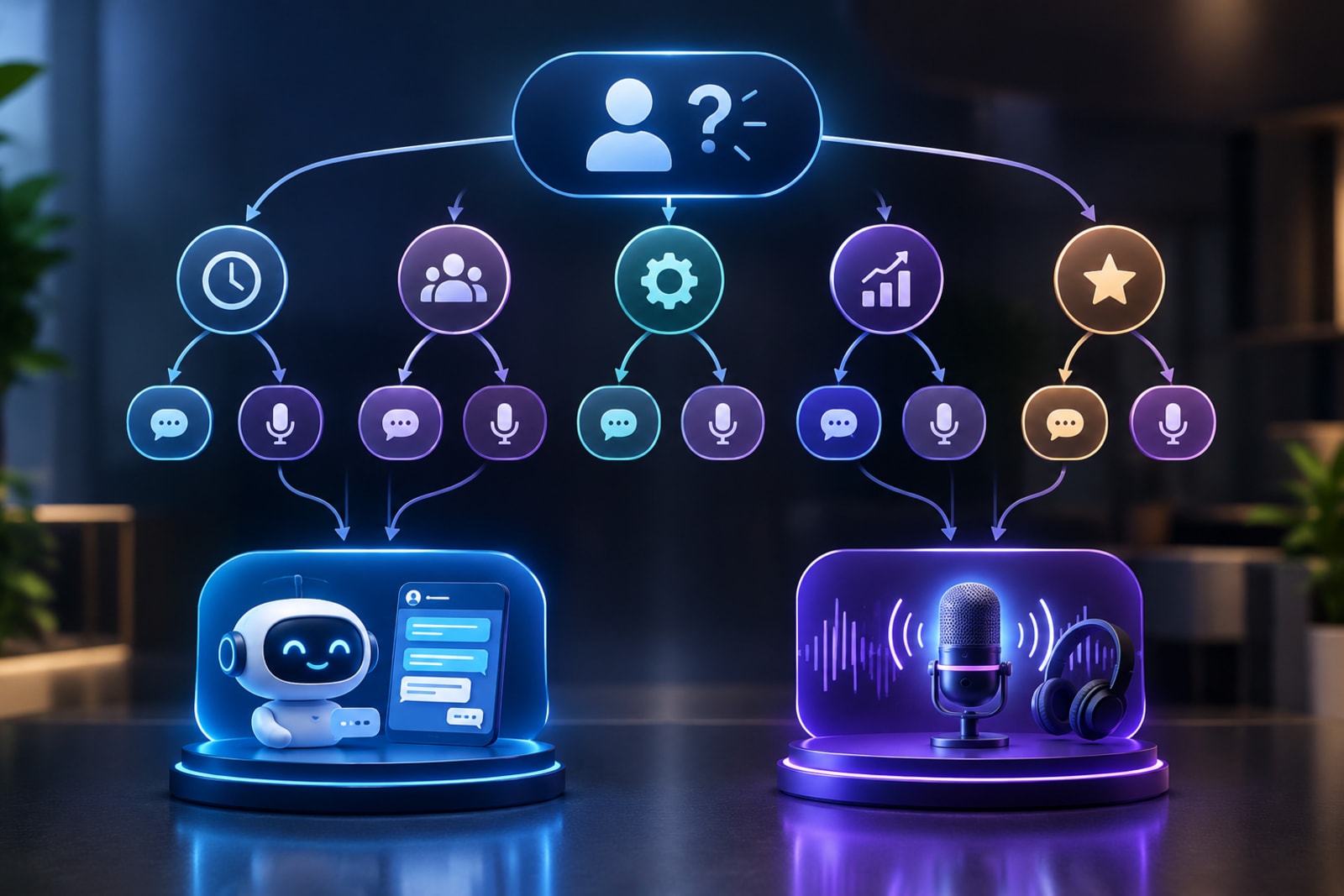
Still unsure which to choose? Answer these five questions honestly:
Question 1: Where Do Most Customer Interactions Happen Today?
Count your communication channels over the last month. How many phone calls versus website chats, WhatsApp messages, emails or social media DMs?
If 60%+ are phone calls: Voice agent priority
If 60%+ are digital messages: Chatbot priority
If fairly split: Start with the channel causing more operational pain
Question 2: What Problem Costs You the Most Time or Money?
Is it missed phone calls losing appointments? Or is it support team overwhelmed with the same WhatsApp questions repeatedly?
Time drain from calls: Voice agent
Time drain from messages: Chatbot
Question 3: What Does Your Customer Demographic Prefer?
Age, tech comfort level and industry norms matter.
Younger, digital-native audience: Chatbot
Older or less tech-savvy audience: Voice agent
Professional services (legal, finance, healthcare): Voice agent
E-commerce, SaaS, online services: Chatbot
Question 4: What's Your Realistic Budget for Year One?
Be honest about what you can commit without straining cash flow.
Under ₹1,50,000 first year: Start with basic chatbot
₹2,00,000 to ₹4,00,000 first year: Either mid-level chatbot or basic voice agent
Above ₹4,00,000 first year: Advanced options or potentially both systems
Question 5: Do You Need Visual Support in Conversations?
Can your customer queries be answered with text, images, links and documents? Or is everything verbal?
Visual aids help significantly: Chatbot
Purely conversational information: Voice agent works fine
Real Business Scenarios: What We'd Recommend
Let me walk you through specific business types and what makes sense:
Mumbai-based dental clinic, 40 calls daily, mostly appointment bookings:
Recommendation: AI voice agent. Directly solves appointment management, reduces receptionist workload, zero missed calls.
E-commerce fashion brand, 80+ daily WhatsApp queries about sizes, delivery, returns:
Recommendation: AI chatbot. Handles FAQs instantly, can send size charts and product images, available 24/7.
B2B SaaS company, leads come via website, need qualification before sales calls:
Recommendation: AI chatbot. Captures lead info, qualifies based on company size and needs, books demos automatically.
Home services company (plumbing, electrical), customers call for emergencies:
Recommendation: AI voice agent. Immediate response critical, can dispatch based on location and urgency, sends technician details via SMS after call.
Online coaching business, customers research programs before buying:
Recommendation: AI chatbot. Prospect takes time comparing options, chatbot nurtures with course details, testimonials, pricing, then books consultation calls.
Real estate agency, property inquiries come via calls and WhatsApp:
Recommendation: Both, but voice agent first. Phone calls indicate higher intent, immediate booking increases conversion.
Working with 4Byte Agency for Your AI Automation
Whether you need a chatbot, voice agent or both, 4Byte Agency builds custom solutions that integrate seamlessly with your existing business systems.
We don't push generic templates. We analyze your actual communication patterns, customer behavior and operational workflows before recommending the right automation approach.
You work directly with our founders and senior engineers. We provide fixed written quotes, complete code ownership and hands-on support during and after implementation.
Based in Malad West, Mumbai, we serve businesses across India and internationally including the USA, UK, UAE and Saudi Arabia.
Start with a free consultation:
📞 +91 79771 33658
📧 contact@4byte.agency
🌐 https://www.4byte.agency
Final Recommendation: Start Where It Hurts Most
Don't overthink this decision. The right choice is the one that removes your biggest operational bottleneck right now.
If phone calls are drowning your team, build a voice agent. If message overload is the problem, implement a chatbot.
Start with one. Do it well. Measure the impact over 60 days. Then expand based on real results, not assumptions.
The businesses winning with AI automation in 2026 aren't the ones using every possible tool. They're the ones solving real problems with the right tool, executed properly and optimized continuously.