
Businesses today aren't asking whether they should adopt AI automation. They're asking how fast they can implement it without breaking what already works.
If you're a business owner, operations manager or founder trying to understand AI automation beyond the hype, this guide will walk you through what actually matters in 2026. Not theory. Not fluff. Just practical, actionable insights based on what's working right now for real businesses.
By the end of this guide, you'll know exactly what AI automation is, which types fit your business, how to calculate ROI before spending a rupee, and how to implement it without needing a tech team on standby.
What is AI Automation for Business (And What It's Not)
AI automation for Business means using artificial intelligence to handle repetitive tasks, make decisions based on data, and execute workflows without constant human input.
It's not about replacing your team. It's about removing the boring, time-consuming tasks that drain their energy so they can focus on strategy, relationships and growth.
Here's what makes AI automation different from traditional automation:
Traditional automation follows rigid rules. If A happens, do B. It can't adapt or learn. Think of auto-reply emails or scheduled social media posts.
AI automation can understand context, learn from patterns and make decisions. It can handle unstructured data like customer messages, voice calls, documents or images. It improves over time as it processes more information.
Real-World Example
A traditional automation might send a follow-up email 3 days after a demo call.
An AI automation can analyze the tone and content of that demo call, determine if the lead is hot or cold, decide the right message to send, personalize it based on what was discussed, and schedule the follow-up at the optimal time based on past engagement data.
That's the difference.
Why 2026 is the Turning Point for AI Automation in Business
AI tools have existed for years, but 2026 marks a shift where AI automation is no longer expensive, complex or only for enterprise companies.
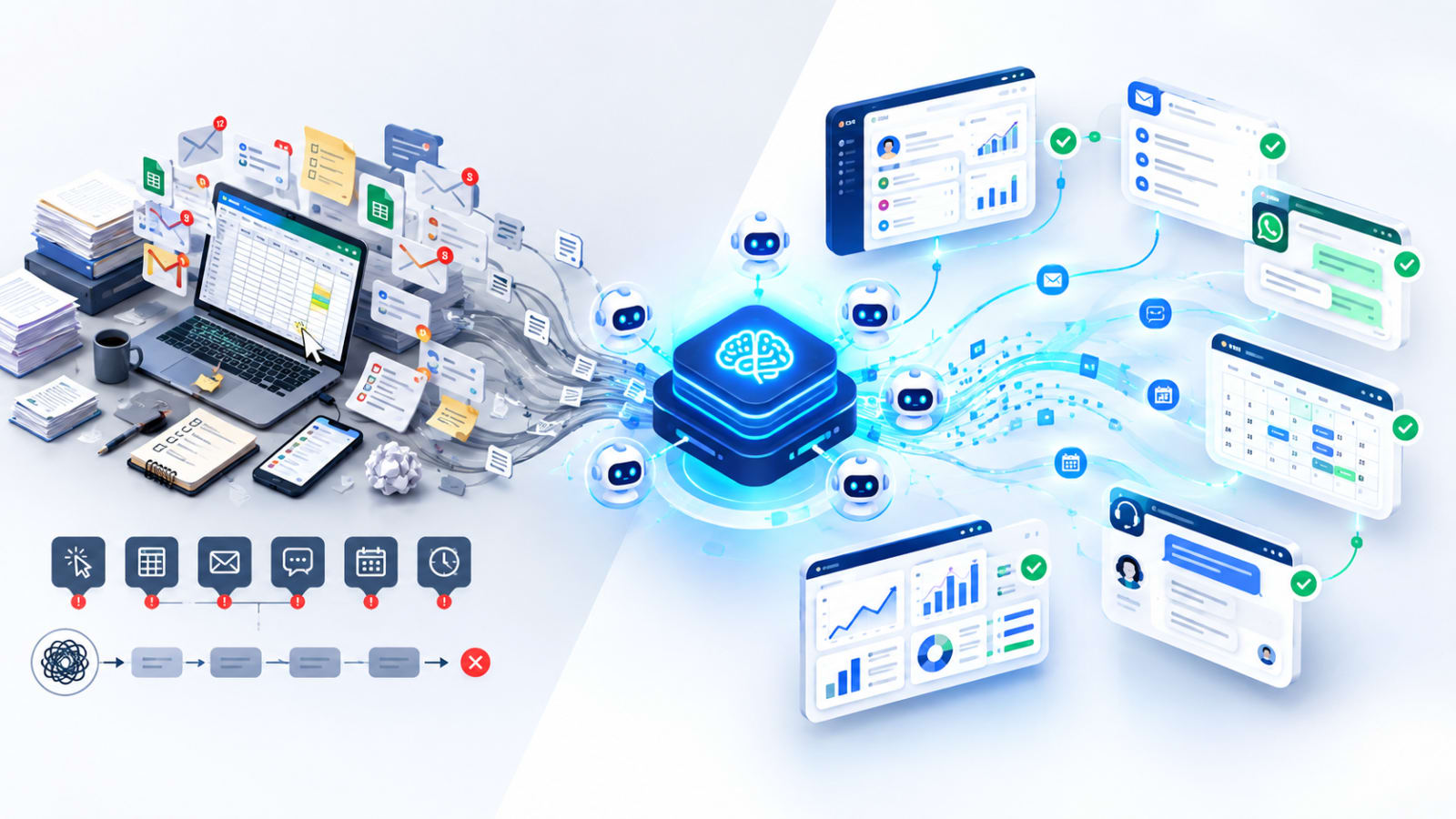
Here's what changed:
Cost has dropped dramatically. What used to cost lakhs in custom development can now be built for a fraction using AI agent platforms, APIs and low-code tools.
Integration became easier. Modern AI tools connect seamlessly with CRMs, email platforms, calendars, payment systems and project management software without needing deep technical expertise.
Quality improved massively. Voice agents now sound human. Chatbots understand context across multiple messages. Workflow automation handles edge cases that would have broken older systems.
Small businesses can now compete. You don't need a 50-person team to deliver enterprise-level service when AI handles tier-1 support, lead qualification, appointment booking and follow-ups automatically.
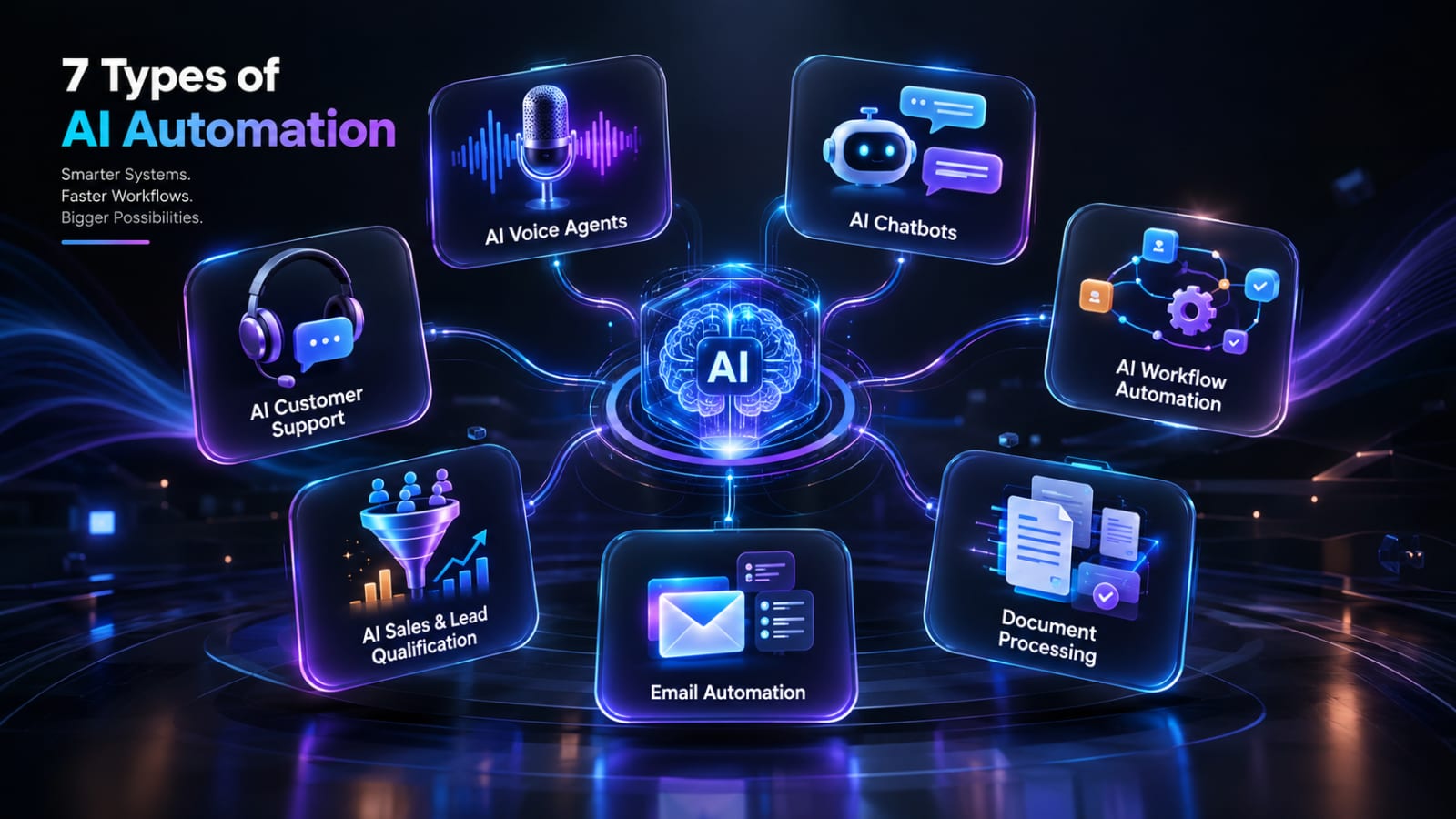
Types of AI Automation Every Business Should Know
AI automation isn't one thing. It's a category that includes multiple tools and approaches. Understanding which type solves which problem is the key to smart implementation.
1. AI Voice Agents
AI voice agents answer phone calls, book appointments, qualify leads, handle support queries and even conduct surveys without human involvement.
They sound natural, understand regional accents, handle interruptions and route complex queries to the right team member when needed.
Best for: Businesses that get a high volume of inbound calls like clinics, salons, service providers, real estate agencies and support-heavy companies.
What they replace: Receptionists handling repetitive calls, tier-1 support agents, appointment booking staff.
Cost in 2026: ₹8,000 to ₹40,000 per month depending on call volume and features.
Time saved: 15 to 30+ hours per week.
2. AI Chatbots (Text-Based Conversational Agents)
AI chatbots handle website chat, WhatsApp, Instagram DMs, Facebook Messenger and email queries in real time, 24/7.
Unlike basic rule-based bots, modern AI chatbots understand intent, remember conversation history and provide personalized responses.
Best for: E-commerce stores, SaaS companies, consultancies, agencies and any business where customers ask questions before buying.
What they replace: Support agents answering FAQs, sales teams qualifying basic leads, customer success handling routine queries.
Cost in 2026: ₹5,000 to ₹25,000 per month depending on platform and volume.
Time saved: 10 to 20 hours per week.
3. AI Workflow Automation
This type connects multiple tools and triggers actions based on events or conditions without manual input.
For example, when a lead fills out a form, AI can score the lead based on behavior, add it to your CRM, send a personalized email, notify the right salesperson on Slack and schedule a follow-up task automatically.
Best for: Sales teams, marketing agencies, HR departments, operations managers, project-based businesses.
What they replace: Manual data entry, follow-up reminders, status updates, report generation.
Cost in 2026: ₹10,000 to ₹50,000 setup + ₹3,000 to ₹15,000 per month for platform subscriptions.
Time saved: 10 to 15+ hours per week per team member.
4. AI Document Processing and Data Extraction
AI reads invoices, receipts, contracts, forms, IDs or any document, extracts relevant data and inputs it into your system without human typing.
Best for: Accounting firms, legal teams, logistics companies, HR departments, insurance providers.
What they replace: Data entry clerks, document verification teams, manual invoice processing.
Cost in 2026: ₹15,000 to ₹60,000 one-time setup + usage-based pricing (₹2 to ₹10 per document).
Time saved: 20 to 40+ hours per month depending on document volume.
5. AI-Powered Email and Communication Automation
AI drafts personalized emails, responds to customer queries, sends follow-ups based on triggers and even negotiates meeting times by analyzing calendar availability.
Best for: Sales teams, recruiters, customer support, consultants, agencies.
What they replace: Manual email drafting, copy-paste responses, back-and-forth scheduling emails.
Cost in 2026: ₹3,000 to ₹20,000 per month depending on email volume and complexity.
Time saved: 5 to 12 hours per week.
6. AI Sales and Lead Qualification
AI analyzes leads based on behavior, engagement, firmographics and past interactions. It scores them, routes hot leads to sales, nurtures cold ones automatically and predicts which leads are likely to convert.
Best for: B2B companies, SaaS businesses, real estate, high-ticket service providers.
What they replace: SDRs doing manual lead research, sales teams chasing unqualified leads.
Cost in 2026: ₹12,000 to ₹50,000 per month.
Time saved: 8 to 15 hours per week per sales rep.
7. AI Customer Support and Helpdesk Automation
AI handles tier-1 support queries, searches knowledge bases, suggests solutions and escalates only when necessary. It learns from past tickets to improve responses over time.
Best for: SaaS products, e-commerce, subscription businesses, service companies.
What they replace: Level-1 support agents, FAQ responders, ticket routers.
Cost in 2026: ₹10,000 to ₹35,000 per month.
Time saved: 15 to 25+ hours per week.
How AI Automation Actually Saves Time (With Real Examples)
Let's break down how businesses are using AI automation today and the tangible time saved.
Example 1: Healthcare Clinic in Mumbai
Problem: 40 to 50 appointment calls daily. Receptionist overwhelmed, patients waiting on hold, missed calls leading to lost bookings.
Solution: AI voice agent handles appointment booking, rescheduling and basic queries.
Result: Receptionist now focuses on in-clinic patients. Zero missed calls. 18 hours saved per week.
Example 2: Digital Marketing Agency
Problem: Sales team spending 12+ hours weekly on lead qualification calls, many turning out to be poor fits.
Solution: AI chatbot on website qualifies leads by asking budget, timeline and service needs before booking a call.
Result: Only qualified leads reach the sales team. Close rate increased by 35%. 12 hours saved per week.
Example 3: E-Commerce Business
Problem: 100+ daily customer queries on WhatsApp about order status, return policy, product details.
Solution: AI chatbot handles 80% of queries instantly, escalates complex ones to support team.
Result: Support team handles only 20 queries instead of 100. Response time under 1 minute. 20+ hours saved weekly.
Example 4: Accounting Firm
Problem: 200+ invoices monthly, manually entering data into accounting software taking 30+ hours.
Solution: AI document processing extracts invoice data, validates it and uploads to software automatically.
Result: 28 hours saved per month. Error rate dropped to near zero.
How to Calculate AI Automation ROI Before You Invest
Most businesses hesitate because they don't know if the investment will pay off. Here's a simple framework to calculate ROI before committing.
Step 1: Identify the Task You Want to Automate
Be specific. "Customer support" is vague. "Answering order status queries on WhatsApp" is clear.
Step 2: Calculate Current Time Spent
How many hours per week does your team spend on this task? Multiply by hourly cost (salary divided by working hours).
Example: 15 hours per week x ₹300 per hour = ₹4,500 per week = ₹18,000 per month.
Step 3: Estimate Automation Coverage
AI won't handle 100% of tasks initially. Be realistic. If AI can handle 70% of queries, calculate time saved accordingly.
Example: 70% of 15 hours = 10.5 hours saved per week = 42 hours per month.
Step 4: Calculate Monthly Savings
Multiply hours saved by hourly cost.
Example: 42 hours x ₹300 = ₹12,600 saved per month.
Step 5: Subtract Automation Cost
If AI automation costs ₹8,000 per month, your net savings = ₹12,600 minus ₹8,000 = ₹4,600 per month.
Annual net savings: ₹4,600 x 12 = ₹55,200
ROI percentage: (₹55,200 / ₹96,000 annual cost) x 100 = 57.5% ROI
Step 6: Factor in Non-Financial Benefits
Time saved isn't the only benefit. Also consider faster response times leading to better customer satisfaction, ability to handle more volume without hiring, reduced human error, 24/7 availability and team morale improving as boring tasks are removed.
Common Myths About AI Automation (And the Reality)
Myth 1: AI Automation is Only for Large Companies
Reality: Small businesses benefit more because every hour saved has a bigger impact. A solo consultant automating lead qualification gains back 8 to 10 hours weekly to focus on delivery and growth.
Myth 2: It's Too Expensive
Reality: In 2026, AI automation starts as low as ₹5,000 per month. Compare that to hiring even a part-time employee at ₹15,000 to ₹20,000 monthly.
Myth 3: You Need a Tech Team to Implement It
Reality: Modern AI tools are built for non-technical users. Platforms like Make, Zapier with AI modules, Voiceflow and many others offer visual builders. For complex needs, a one-time setup by a development partner gets you running without ongoing tech dependency.
Myth 4: AI Will Replace My Team
Reality: AI removes repetitive tasks. Your team shifts focus to higher-value work like strategy, relationship building, creative problem solving and customer success. Businesses using AI automation typically grow their teams because they can handle more volume and serve more clients.
Myth 5: Setup Takes Months
Reality: Simple automation like chatbots or workflow triggers can go live in 1 to 2 weeks. More complex builds like voice agents or custom integrations take 3 to 6 weeks.
How to Start with AI Automation (Step-by-Step)
If you're ready to explore AI automation for your business, here's the practical roadmap.
Step 1: Identify Your Biggest Time Drain
Look at your team's daily activities. What repetitive task takes the most time? Start there. Don't try to automate everything at once.
Step 2: Define Clear Goals
What does success look like? Save 10 hours per week? Respond to customers in under 2 minutes? Qualify 50 leads per month automatically? Specific goals make it easier to measure results.
Step 3: Choose the Right Type of AI Automation
Based on your biggest time drain, pick the automation type that fits. Customer calls? Voice agent. Website queries? Chatbot. Manual data work? Workflow automation or document AI.
Step 4: Start Small with a Pilot
Don't automate your entire customer journey on day one. Pick one process. Test it for 2 to 4 weeks. Gather feedback. Refine. Then expand.
Step 5: Work with the Right Implementation Partner
If you're not technical, find a development partner experienced in AI automation. Look for clear communication, fixed scope pricing, proven past work and post-launch support.
At 4Byte Agency, we build custom AI automation solutions including voice agents, chatbots and workflow automation for businesses across Mumbai and globally. You work directly with founders and senior engineers, get fixed written quotes and own the full system after delivery.
Step 6: Train Your Team
AI doesn't replace your team, it supports them. Make sure everyone understands how the automation works, when to step in and how to handle edge cases the AI escalates.
Step 7: Measure and Optimize
Track time saved, cost reduction, customer satisfaction and error rates. Most AI systems improve over time as they learn from interactions. Review performance monthly and optimize based on real data.
What to Look for in an AI Automation Partner
If you're outsourcing implementation, here's what matters:
Proven experience with AI tools and platforms. Ask for live examples, not just portfolio images.
Clear communication. Can they explain how the system works in simple terms?
Fixed pricing with written scope. No surprise costs halfway through.
Full ownership and access. You should own the automation, code and all credentials after delivery.
Post-launch support. AI systems need fine-tuning in the first few weeks. Make sure support is included.
Integration capability. Can they connect with your existing CRM, email tools, calendar and other systems?
The Future of AI Automation (What's Coming Next)
AI automation in 2026 is just the beginning. Here's what's on the horizon:
AI agents will become proactive, not just reactive. Instead of waiting for a customer query, they'll reach out at the right moment with personalized offers or support.
Multimodal AI will combine text, voice, image and video understanding in one workflow. Imagine an AI that can analyze a product image sent via WhatsApp, check inventory and confirm availability in seconds.
Hyper-personalization at scale. AI will tailor every customer interaction based on past behavior, preferences and context without manual input.
No-code AI builders will become mainstream. Business owners will be able to build and deploy AI automation without writing a single line of code.
Regulation and transparency standards will mature. Businesses using AI will need to be clear about when customers are interacting with AI versus humans.
The businesses that start experimenting with AI automation now will have a massive advantage as these advancements roll out over the next 2 to 3 years.
Final Thoughts: Start Small, Think Long-Term
AI automation isn't about overnight transformation. It's about consistent, incremental improvements that compound over time.
Start with one task. Automate it well. Measure the impact. Then move to the next.
The businesses winning in 2026 aren't the ones with the fanciest AI. They're the ones using AI to remove friction, serve customers faster and free their teams to do work that actually moves the business forward.
If you're ready to explore how AI automation can fit into your business without the complexity or confusion, we're here to help. Book a free consultation with our team at 4Byte Agency and let's map out what makes sense for your goals.
Contact 4Byte Agency:
📍 98-103, 4th Floor, Aditya Industrial Estate, Behind Evershine Mall, Chincholi Bunder, Malad West, Mumbai 400064
📞 +91 79771 33658
📧 contact@4byte.agency
🌐 https://www.4byte.agency