

You've read about AI automation. You've seen the case studies. You understand the benefits in theory.
But here's the question that actually matters: will it be worth it for your specific business, with your budget, your team size and your current operations?
Not for some hypothetical company in a blog post. For you.
ROI (Return on Investment) is the only metric that answers this honestly. Not buzzwords. Not promises. Just cold, clear numbers that tell you whether investing in AI automation makes financial sense.
This guide gives you the complete framework to calculate AI automation ROI before spending a single rupee. You'll get step-by-step formulas, real calculations with actual numbers, scenarios covering different business types and a decision matrix to determine if now is the right time.
By the end, you'll know exactly how to build your own ROI calculation for any AI automation project, whether it's a chatbot, voice agent, workflow automation or document processing.
Why Most Businesses Get ROI Calculations Wrong
Before we build the right framework, let's address why most ROI calculations fail to predict actual results.
Only Counting Direct Labor Savings
Most calculations only look at "if this costs twenty thousand monthly and we save fifteen hours of a salary, we break even."
This ignores opportunity cost, quality improvements, customer experience impact, error reduction, scalability potential and competitive advantage.
Overestimating Automation Coverage
Sellers claim "automate ninety percent of support queries" when reality is closer to sixty to seventy percent in the first three months.
Honest ROI calculations use conservative estimates, not best-case scenarios.
Underestimating Implementation Costs
Quoted price is rarely total cost. Hidden expenses include team time spent on setup and training, temporary productivity dip during transition, integration work with existing systems and optimization time in first sixty days.
Ignoring Time to Value
An automation that takes six months to implement and another three months to optimize has very different ROI than one delivering value in four weeks.
Time to value matters as much as total value delivered.
Not Accounting for Maintenance and Evolution
AI automation isn't set and forget. It needs ongoing refinement, periodic updates, platform subscription renewals and adjustment as your business evolves.
Accurate ROI includes total cost of ownership, not just initial investment.
The Complete ROI Calculation Framework
This framework works for any AI automation project. We'll walk through each component with explanation and examples.

Component 1: Total Implementation Cost
This is everything you spend to get the automation fully operational.
The formula looks at development or setup cost plus platform or software licensing plus integration work plus team time investment plus training plus a buffer for unexpected expenses.
Let's use a real example with an AI chatbot for an e-commerce business.
Development and setup costs sixty thousand rupees. Platform subscription for the year is forty eight thousand. Integration with existing CRM and order system costs twenty five thousand. Internal team invests forty hours at five hundred rupees per hour equivalent, totaling twenty thousand. Training and documentation costs eight thousand. Adding a ten percent buffer for unexpected costs gives us sixteen thousand one hundred.
Total implementation cost comes to one lakh seventy seven thousand one hundred rupees.
Component 2: Ongoing Monthly Operating Cost
This is what you pay every month to keep the automation running.
Calculate your monthly operating cost by adding platform subscription plus API or usage charges plus maintenance costs plus monitoring and support plus optimization time.
For the same chatbot example, monthly platform subscription is five thousand five hundred. API usage charges run around two thousand monthly. Maintenance and updates cost four thousand. Monthly monitoring and optimization requiring about five hours costs two thousand five hundred.
Total monthly operating cost equals fourteen thousand rupees.
Annual operating cost becomes one lakh sixty eight thousand rupees.
Component 3: Direct Time Savings Value
Calculate actual hours saved and convert to monetary value.
The formula is hours saved per week multiplied by four point three three weeks, then multiplied by hourly employee cost.
To find hourly cost, take monthly salary plus benefits and divide by one hundred seventy three working hours.
For our chatbot example, the current manual process has a support agent handling eighty queries daily at an average six minutes per query. That's four hundred eighty minutes daily which equals eight hours. The support agent earns twenty five thousand monthly. Their hourly cost is twenty five thousand divided by one hundred seventy three, which equals one hundred forty four rupees fifty paise.
After automation, the chatbot handles sixty five percent of queries which is fifty two queries. The agent now handles the remaining twenty eight queries. Agent time becomes one hundred sixty eight minutes or two point eight hours daily. Time saved equals five point two hours daily which is twenty six hours weekly.
Monthly time savings value becomes twenty six hours times four point three three weeks times one hundred forty four rupees fifty paise, equaling sixteen thousand two hundred eighty rupees monthly.
Annual direct savings total one lakh ninety five thousand three hundred sixty rupees.
Component 4: Indirect Value Gains
These are harder to quantify but equally real. Assign conservative monetary value based on your business metrics.
Increased capacity without new hires means if automation allows you to handle thirty percent more volume without hiring, calculate the cost you avoided.
If you would have needed a second support agent in three months at twenty five thousand monthly, automation delayed or eliminated that need. That's twenty five thousand monthly in avoided cost, totaling three lakh rupees annually.
Faster response times improving conversion matters significantly. If response time drops from four hours to five minutes and historical data shows faster response increases conversion by even five percent, calculate the revenue impact.
Consider one thousand monthly inquiries where fifteen percent convert currently at an average order of three thousand rupees. Current revenue is one thousand times fifteen percent times three thousand, equaling four lakh fifty thousand rupees.
With five percent improvement, you get one thousand times fifteen point seven five percent times three thousand, equaling four lakh seventy two thousand five hundred. The value gained is twenty two thousand five hundred monthly or two lakh seventy thousand annually.
Error reduction cost savings come from comparing current manual process errors versus automated accuracy.
If three percent of manual data entries have errors requiring twenty minutes to fix, and you process two hundred entries monthly, that's six errors taking two hours monthly to fix. The value saved is two hours times one hundred forty four rupees fifty paise times twelve months, equaling three thousand four hundred sixty eight rupees annually.
Extended operating hours with twenty four seven availability captures inquiries outside business hours that previously went unanswered.
If you receive fifteen inquiries nightly and eight percent convert at three thousand rupees average order value, that's fifteen times thirty days times eight percent times three thousand, equaling one lakh eight thousand monthly or twelve lakh ninety six thousand annually. This number is significant.
Employee satisfaction and retention improves when you remove boring, repetitive tasks. Replacing an employee costs fifty to two hundred percent of their annual salary.
If automation contributes to avoiding one resignation every two years with replacement cost around one lakh rupees, that values at fifty thousand rupees annually.
Total indirect value using conservative estimates reaches twenty lakh nineteen thousand four hundred sixty eight rupees annually.
Component 5: Implementation Timeline Impact
How quickly you start seeing value affects overall ROI.
Calculate effective first year value by taking annual value and multiplying by months operational divided by twelve.
In our chatbot example, if implementation takes six weeks and optimization another four weeks, you're fully operational in two and a half months. Effective operational time in year one becomes nine and a half months.
Adjusted first year direct savings become one lakh ninety five thousand three hundred sixty rupees times nine point five divided by twelve, equaling one lakh fifty four thousand six hundred eighteen rupees.
Adjusted first year indirect value becomes twenty lakh nineteen thousand four hundred sixty eight rupees times nine point five divided by twelve, equaling fifteen lakh ninety eight thousand seven hundred three rupees.
Complete ROI Calculation
Now we combine everything into the final ROI calculation using the standard formula.
ROI percentage equals total gain minus total cost, divided by total cost, multiplied by one hundred.
For first year:
Total cost year one includes implementation of one lakh seventy seven thousand one hundred plus operating cost for nine point five months. Operating cost is one lakh sixty eight thousand times nine point five divided by twelve, equaling one lakh thirty three thousand. Total cost becomes three lakh ten thousand one hundred rupees.
Total gain year one includes direct savings of one lakh fifty four thousand six hundred eighteen plus indirect value of fifteen lakh ninety eight thousand seven hundred three. Total gain equals seventeen lakh fifty three thousand three hundred twenty one rupees.
Year one ROI calculation: seventeen lakh fifty three thousand three hundred twenty one minus three lakh ten thousand one hundred, divided by three lakh ten thousand one hundred, multiplied by one hundred equals four hundred sixty five percent ROI.
Payback period is three lakh ten thousand one hundred divided by one lakh fifty three thousand two hundred seventy six monthly gain, equaling roughly two months.
For ongoing years after year one:
Total annual cost becomes only one lakh sixty eight thousand rupees since there's no implementation cost.
Total annual gain with full twelve months operation reaches twenty one lakh fourteen thousand eight hundred twenty eight rupees.
Ongoing ROI equals twenty one lakh fourteen thousand eight hundred twenty eight minus one lakh sixty eight thousand, divided by one lakh sixty eight thousand, multiplied by one hundred, giving eleven hundred fifty nine percent ROI.
Even if we're overly conservative and cut indirect benefits by fifty percent, the ROI remains strongly positive.
Real Business ROI Examples Across Different Scenarios
Let's calculate ROI for various business types and automation projects to show how this works in practice.
Scenario 1: AI Voice Agent for Dental Clinic
A dental clinic receives thirty five to forty five calls daily, mostly for appointment bookings. The receptionist spends over three hours daily on phones. The clinic operates six days weekly and misses eight to twelve calls daily during peak times.
Implementation cost includes voice agent setup at ninety thousand rupees. Platform and telephony costs eighteen thousand monthly.
Direct savings come from freeing up fifteen hours of receptionist time weekly, which is sixty five hours monthly. With hourly cost at one hundred forty four rupees fifty paise, monthly direct savings equal nine thousand three hundred ninety two rupees.
Indirect value comes from zero missed calls. Ten calls daily times six days times four point three three weeks equals two hundred sixty calls monthly. At forty percent conversion rate, that's one hundred four appointments. With average appointment value of two thousand five hundred rupees, additional revenue reaches two lakh sixty thousand monthly.
Annual ROI calculation shows cost year one at ninety thousand plus eighteen thousand times ten months equaling two lakh seventy thousand rupees. Gain year one equals nine thousand three hundred ninety two plus two lakh sixty thousand, times ten months, totaling twenty six lakh ninety three thousand nine hundred twenty rupees.
ROI reaches eight hundred ninety seven percent with payback in just one month.
Scenario 2: Workflow Automation for Marketing Agency
An eight person agency spends twelve hours monthly on manual client reporting, six hours on invoice generation and tracking, and ten hours on lead data entry and CRM updates.
Implementation cost for three workflow setups is one lakh twenty thousand. Platform fees run eight thousand monthly with maintenance at five thousand monthly.
Direct savings total twenty eight hours monthly at average team hourly cost of three hundred fifty rupees, equaling nine thousand eight hundred rupees monthly.
Indirect value includes faster invoicing reducing payment delays by seven days average. With monthly invoicing of six lakh rupees and opportunity cost at twelve percent annual, the value is six lakh times twelve percent times seven divided by three hundred sixty five, equaling one thousand three hundred eighty rupees monthly. Additional capacity allows taking two more clients annually at sixty thousand each.
Annual ROI calculation shows cost year one at one lakh twenty thousand plus thirteen thousand times ten months equaling two lakh fifty thousand. Gain year one equals nine thousand eight hundred plus one thousand three hundred eighty times ten months plus one lakh twenty thousand, totaling two lakh thirty one thousand eight hundred.
Year one ROI is negative seven percent, but year two with cost of one lakh fifty six thousand and gain of two lakh fifty four thousand one hundred sixty shows sixty three percent ROI with payback at thirteen months.
This demonstrates not every automation has instant ROI but delivers long term value.
Scenario 3: Document Processing for Accounting Firm
An accounting firm processes two hundred invoices monthly with manual data entry taking five minutes per invoice. Error rate sits at eight percent requiring fifteen minutes to fix each error.
Implementation cost for AI document processing setup is one lakh fifty thousand. Per document processing fee is five rupees with platform at six thousand monthly.
Direct savings come from time saved on two hundred invoices times five minutes equaling one thousand minutes or sixteen point seven hours monthly. Error fixes saved equal sixteen errors times fifteen minutes which is two hundred forty minutes or four hours monthly. Total time saved is twenty point seven hours monthly at hourly cost of two hundred rupees, equaling four thousand one hundred forty rupees monthly savings.
Indirect value comes from processing capacity. Processing two hundred invoices now takes two hours instead of twenty hours. This allows taking on two additional clients at twenty five thousand monthly each without new hires, adding fifty thousand monthly revenue.
Annual ROI shows cost year one at one lakh fifty thousand plus six thousand plus one thousand usage times ten months equaling two lakh twenty thousand. Gain year one equals four thousand one hundred forty plus fifty thousand times ten months totaling five lakh forty one thousand four hundred.
ROI reaches one hundred forty six percent with four month payback period.
The ROI Decision Matrix: Should You Invest Now?
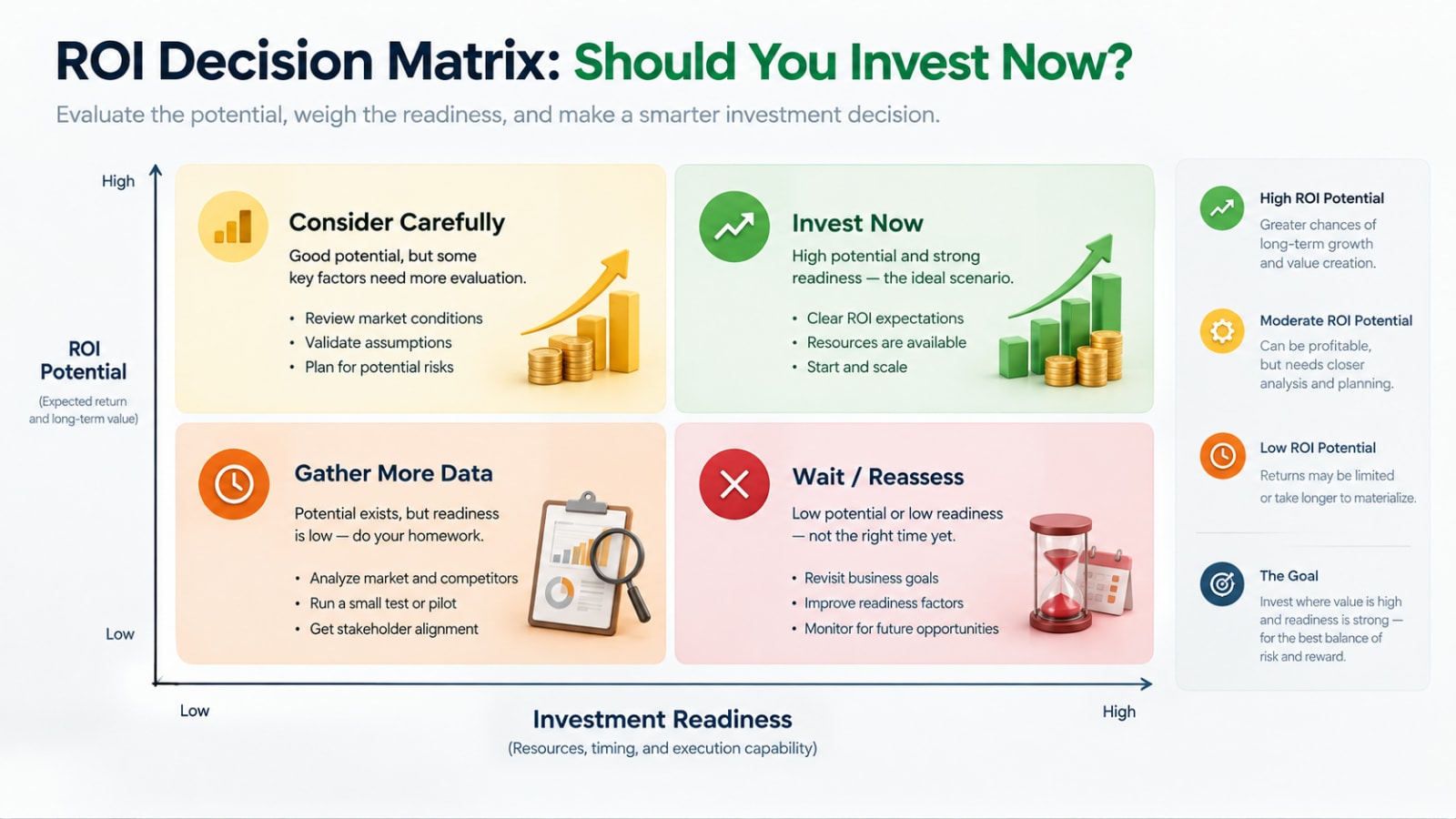
Even with positive ROI calculations, timing matters. Use this framework to decide if now is the right time.
Green light scenarios where you should go ahead:
Payback period is under six months. Year one ROI exceeds one hundred percent. You have budget available without taking debt. The manual process is actively costing you customers or revenue. Your team is overwhelmed and cannot scale the current approach. Implementation will not disrupt critical operations.
Yellow light scenarios requiring caution:
Payback period falls between six to twelve months. Year one ROI ranges from twenty five to one hundred percent. Implementation requires financing but remains manageable. Manual process is painful but not yet breaking. Team is busy but not completely overwhelmed. Implementation requires significant change management.
For yellow light situations, start with a smaller pilot project to prove value before expanding.
Red light scenarios suggesting you should wait:
Payback period exceeds twelve months. Year one ROI falls below twenty five percent. Investment would require debt you cannot comfortably service. Manual process works adequately and automation is merely nice to have. Team shows resistance to change with no plan to address concerns. Your business model or processes are about to change significantly.
For red light scenarios, revisit in six months or focus on process optimization before considering automation.
Working with 4Byte Agency for ROI-Focused AI Automation
At 4Byte Agency, we don't just build AI automation. We help you calculate realistic ROI before you commit.
Our process includes an ROI assessment workshop where we analyze your workflows and calculate potential savings together. We provide transparent fixed price quotes with no hidden costs. Implementation happens in phases so you see value quickly and can adjust. We define measurable success metrics upfront and track post launch ROI to verify actual versus projected results.
You work directly with our founders and senior engineers who understand both technology and business economics.
Start with a free ROI consultation by calling us at plus ninety one seven nine seven seven one three three six five eight, emailing contact at 4byte dot agency, or visiting our website at 4byte dot agency.
Our office is located at ninety eight to one oh three, fourth floor, Aditya Industrial Estate, behind Evershine Mall, Chincholi Bunder, Malad West, Mumbai four hundred zero six four.
We serve businesses across Mumbai, India and internationally including USA, UK, UAE and Saudi Arabia.
Final Thought: ROI is About Value, Not Just Cost Savings
The businesses getting the most from AI automation aren't just cutting costs. They're using saved time and resources to serve more customers, launch new services, improve quality and grow faster than competitors stuck in manual operations.
ROI isn't just about spending less. It's about creating more value with the same resources.
Run the numbers honestly. Be conservative in estimates. Factor in total costs. Then make your decision based on data, not hype.
If the ROI is clearly positive, the question isn't whether to automate. It's how quickly you can start.